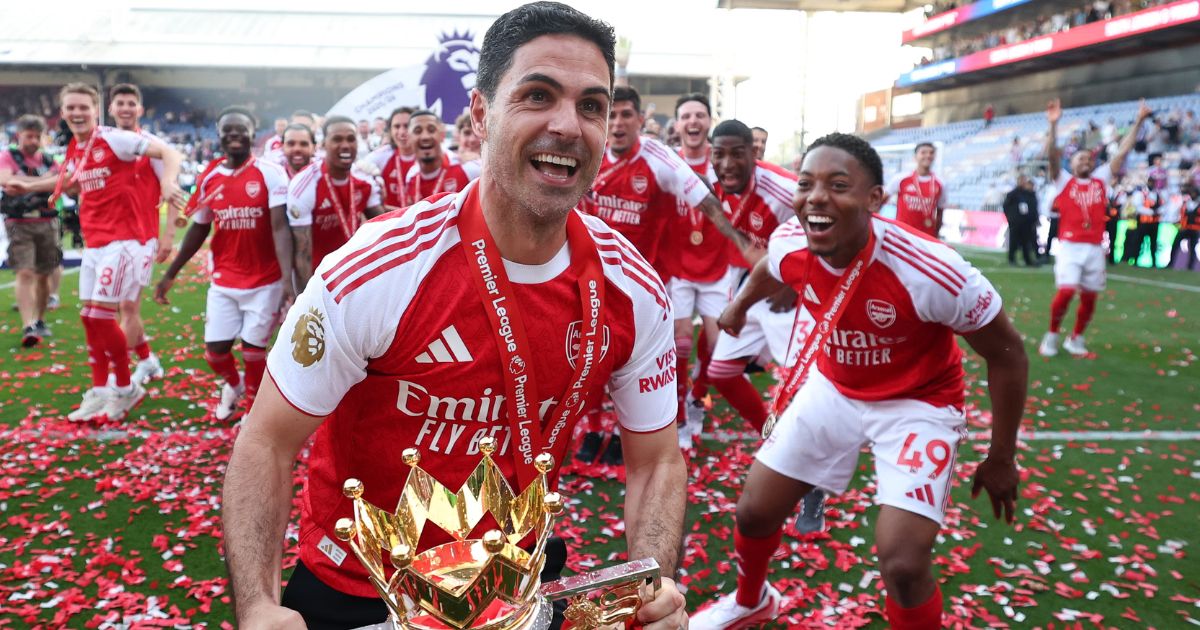
After years of heartbreak, near misses, and finishing second, Arsenal are finally Premier League champions again.
ALSO READ: Are Arsenal Bottling the Premier League Title Again?
Mikel Arteta’s side secured the 2025/26 title, Arsenal’s first league crown in 22 years, after Manchester City dropped points against Bournemouth, ending one of the most emotionally exhausting waits in the club’s modern history.
Unlike previous Arsenal title-winning teams built almost entirely on flair and attacking football, this version of Arsenal won the league through control, adaptability, structure, and maturity.
This was not a team that simply outscored opponents. It was a team that learned how to win every type of game.
For the first time in 22 years, @Arsenal lift the Premier League trophy. 🏆🔴 💥 pic.twitter.com/9WmZWEK7SG
— Premier League (@premierleague) May 24, 2026
The Evolution of Mikel Arteta
Arteta’s Arsenal have evolved significantly over the past three seasons. Earlier versions of this side were often brilliant going forward but vulnerable defensively or mentally during title run-ins. This season felt different from the very beginning.
The manager became more pragmatic.
Rather than insisting on one rigid style, Arsenal adapted depending on the opponent and game state. At times, they dominated possession with a classic positional-play structure. In other matches, they were more compact, direct, and physically aggressive.
That tactical flexibility became one of the defining themes of their title-winning campaign.
Arteta regularly alternated between:
- 4-3-3 structures
- 4-2-3-1 shapes
- Hybrid 3-2-4-1 systems in possession
And crucially, Arsenal became far more comfortable winning ugly.
That’s often the final step for title-winning teams.
Defensive Dominance Won Arsenal the League
If there was one area that truly separated Arsenal from the rest of the league, it was their defence.
For years, Arsenal were criticised for defensive fragility in key moments. This season, they became arguably the hardest team in England to break down.
The partnership of William Saliba and Gabriel Magalhães gave Arsenal:
- physical dominance,
- recovery pace,
- aerial strength,
- and elite positioning.
Behind them, David Raya produced another outstanding campaign, winning his third consecutive Golden Glove.
Arsenal consistently controlled matches without needing chaos.
Opponents struggled to:
- progress centrally,
- create high-quality chances,
- or exploit transitions.
That defensive structure allowed Arsenal to survive difficult periods during the season, where injuries affected several attacking players.
🚨🚨| 𝐑𝐄𝐂𝐎𝐑𝐃: Arsenal are the 𝐅𝐈𝐑𝐒𝐓 club in Premier League history to complete an entire season without conceding a penalty or receiving a red card.
— CentreGoals. (@centregoals) May 24, 2026
❌ NO RED CARDS
❌ NO PENALTIES CONCEDED pic.twitter.com/LUtU9gR8Bn
Declan Rice Became the Complete Midfielder
When Arsenal spent over £100 million on Declan Rice, there was enormous pressure attached to the signing.
This season, he justified every cent.
Rice became the heartbeat of the team:
- breaking up play,
- driving transitions,
- covering defensive spaces,
- contributing decisively in attack.
What made him so important tactically was his versatility. In some games, he operated deeper to protect the defence. In others, Arteta pushed him higher between the lines to increase Arsenal’s attacking intensity.
His consistency across the entire campaign made him one of the strongest contenders for Premier League Player of the Season.
🗣️ DECLAN RICE, HE SAID IT'S NOT DONE!
— NBC Sports Soccer (@NBCSportsSoccer) May 24, 2026
The Arsenal fans have a new chant for their star midfielder! pic.twitter.com/otso7x6Fpg
Set Pieces Became a Serious Weapon
For years, Arsenal were mocked for becoming “set-piece FC.”
This season, those jokes disappeared.
Under set-piece coach Nicolas Jover, Arsenal became devastating from dead-ball situations, scoring a record number of goals from corners and indirect free-kicks.
Their routines were:
- highly choreographed,
- opponent-specific,
- and incredibly difficult to defend.
In tight title races, marginal gains matter enormously.
And Arsenal repeatedly turned set pieces into match-winning moments.
The Attack Was More Balanced Than Previous Seasons
Previous Arsenal teams often relied too heavily on Bukayo Saka or Martin Ødegaard for creativity.
This season, the attacking burden became more distributed.
Bukayo Saka remained central to Arsenal’s attacking identity, but the arrivals and improvement of players like Viktor Gyökeres, Eberechi Eze, and Leandro Trossard gave Arsenal more unpredictability in the final third.
Even when key players missed games through injury, Arsenal rarely looked completely dependent on one individual.
That depth became critical during the second half of the campaign.
The Key Moments That Changed the Title Race
Every title-winning season has defining moments.
For Arsenal, several stood out:
Winning Tight Matches
Unlike previous seasons, where dropped points often followed setbacks, Arsenal consistently responded strongly after disappointing results.
Beating Direct Rivals
Their performances against fellow top-six sides showed maturity and tactical intelligence.
Surviving Injury Problems
Captain Martin Ødegaard and Bukayo Saka struggled with injuries during parts of the season, yet Arsenal continued winning consistently.
Manchester City Finally Slipping
For years, City’s relentless consistency broke Arsenal psychologically.
This season, Arsenal remained composed while City dropped points in key moments, including the decisive draw against Bournemouth that officially handed Arsenal the title.
The Numbers Behind the Title
The statistics underline just how complete Arsenal were this season.
They:
- finished with 85 points
- won 26 league matches
- recorded the league’s best defensive numbers
- and ended with one of the best goal differences in Europe.

BetJets News is crafted by a team of dedicated sports writers and betting experts. With deep knowledge of soccer, cricket, rugby, and more, our contributors deliver insightful tips, match previews, and betting strategies to help you make smarter bets.