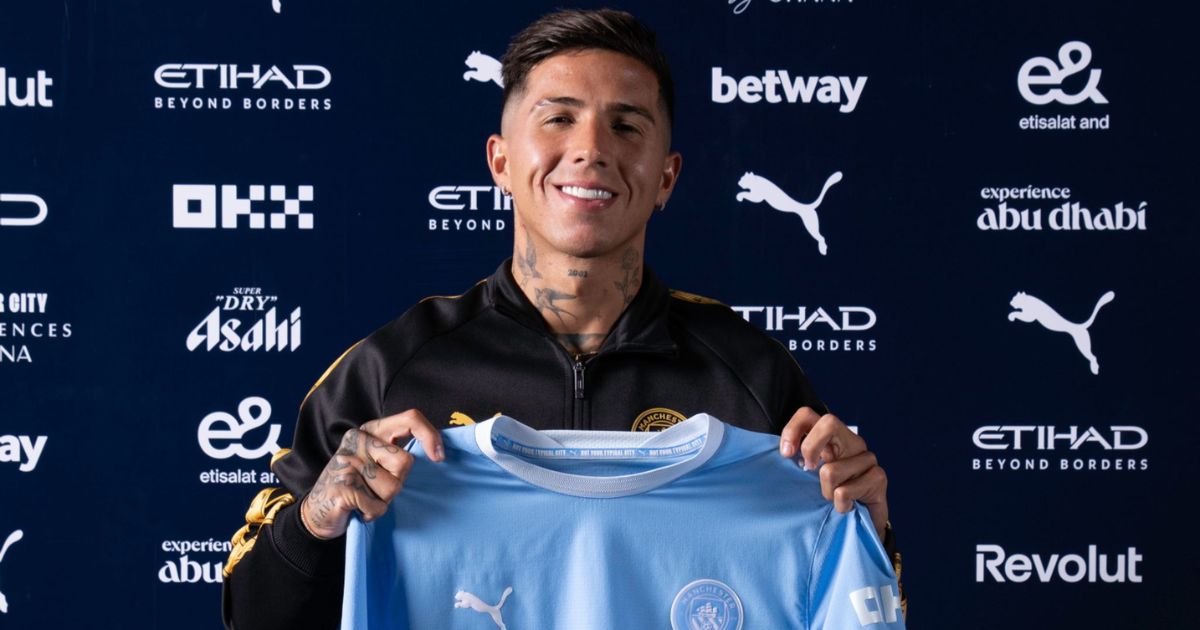
Manchester City have completed one of the most dramatic midfield rebuilds in recent Premier League history, and Enzo Fernandez may prove to be the signing that brings it all together.
ALSO READ: Why Chelsea Can’t Afford To Sell Enzo Fernandez.
The Argentina international completed a £125 million move from Chelsea on deadline day, equalling the British transfer record and signing a five-year contract at the Etihad Stadium. At 25, Fernandez arrives with Premier League experience, a World Cup winner’s medal and major honours at club level, but also with enormous expectations attached to his price tag.
His arrival represents much more than another marquee Manchester City signing. Fernandez is the headline addition to a midfield that has been almost completely reconstructed following the end of Pep Guardiola’s era and the appointment of Enzo Maresca.
Rodri, Bernardo Silva, Tijjani Reijnders and Nico Gonzalez have all departed, leaving City without several of the players who previously provided control, creativity and defensive security through the middle of the pitch. Rather than attempting to replace those qualities with one player, City have invested heavily in building an entirely new midfield unit.
Elliot Anderson arrived from Nottingham Forest for £116 million, teenage midfielder Ayyoub Bouaddi joined from Lille for around £85 million, and Fernandez has now completed a midfield spending spree worth approximately £327 million.
It is an extraordinary investment, but it also gives Maresca the tools to build a midfield with a very different identity.
Enzo Fernández – $169M
— B/R Football (@brfootball) September 1, 2026
Elliot Anderson – $156M
Ayyoub Bouaddi – $110M
Man City's new-look midfield has cost a reported $435M 🤯 pic.twitter.com/YSpMBsiWOM
Fernandez Adds The Quality City Were Missing
Anderson and Bouaddi gave City two exciting building blocks, but Fernandez adds something different.
He is an accomplished passer who is comfortable receiving possession in congested areas, turning under pressure and looking to move the ball forward. Rather than simply recycling possession from side to side, Fernandez regularly attempts to break defensive lines and accelerate attacks.
That ability should be particularly valuable against opponents who sit deep against City.
The Guardiola era was built around extraordinary levels of possession and control, but City occasionally became predictable when confronted by compact defensive blocks. Fernandez gives Maresca a midfielder capable of changing the tempo with one pass, whether that means switching play, finding an attacker between the lines or releasing a runner behind the opposition defence.
He should also provide another reliable route for getting the ball to Erling Haaland.
The Norwegian remains one of the most devastating strikers in world football when supplied early, and Fernandez’s willingness to play forward could allow City to find Haaland before opposition defences have settled into shape. It could make City’s possession more direct without necessarily making it less controlled.
Enzo Fernández is here 🤝 pic.twitter.com/NWyxbpGquy
— Manchester City (@ManCity) September 1, 2026
More Than A Deep-Lying Playmaker
Fernandez’s development at Chelsea also showed that there is much more to his game than operating as a traditional deep-lying midfielder.
He became increasingly influential in attacking areas under Maresca, particularly when given licence to move forward from midfield and arrive around the penalty area. His ability to make late runs, combine around the box and contribute goals added another dimension to his game.
That versatility should give Maresca considerable tactical flexibility.
Fernandez can drop deeper to help City build possession from the back, but he can also operate as a more advanced No. 8 when the game demands it. Against teams that defend with numbers behind the ball, his ability to move into attacking areas could provide another body around Haaland and City’s creative players.
City themselves described Fernandez as a complete midfielder when announcing his arrival, highlighting his technical ability, work rate, tenacity and goalscoring qualities. Director of football Hugo Viana also pointed to his ability to operate in both possession-based football and more transitional situations.
That versatility may become particularly important as City move into a new tactical era.
Anderson & Fernandez Could Complement Each Other
Perhaps the most intriguing aspect of City’s rebuilt midfield is how Fernandez could combine with Anderson.
The England international arrives with an exceptional reputation for winning possession. Anderson recovered the ball 306 times in the Premier League last season, the highest total among players across Europe’s top five leagues, giving City a midfielder capable of providing enormous energy and defensive aggression.
That could give Fernandez greater freedom.
Rather than asking the Argentine to become the primary defensive midfielder, Maresca could allow Anderson to shoulder more of the ball-winning and space-covering responsibility. Fernandez would then be able to concentrate on receiving possession, progressing attacks and moving into more advanced positions.
A double pivot featuring Anderson and Fernandez could therefore offer a useful balance between physicality and creativity. Anderson can disrupt opposition attacks and recover possession, while Fernandez can help turn those recoveries into attacking opportunities.
Bouaddi gives Maresca another option. At just 18, the Moroccan international does not necessarily need to carry the burden of immediately replacing one of the most important midfielders in City’s history. He can develop within a midfield containing two established Premier League players while gradually earning a bigger role.
City have effectively spread different responsibilities across several midfielders rather than searching for one player capable of doing everything.
Fernandez Is Not A Rodri Replacement
That distinction is particularly important when discussing Rodri.
For much of Guardiola’s reign, City’s midfield revolved around the Spaniard. Rodri could dictate the tempo of matches, receive the ball under intense pressure, protect his defence and position himself almost perfectly whenever City lost possession.
There are very few midfielders capable of replicating that combination of qualities, and Fernandez isn’t one of them.
But that doesn’t mean he needs to be.
Fernandez is naturally more adventurous. He wants to move the ball forward, attack space and become involved closer to the opposition penalty area. Trying to restrict him to Rodri’s old role could actually remove some of the qualities that convinced City to spend £125 million on him.
Instead, Maresca may attempt to replace Rodri collectively.
Anderson can provide some of the defensive aggression and ball-winning. Fernandez can take greater responsibility for progressing possession and creating attacks. Bouaddi can provide another technically gifted option capable of developing into a major part of the midfield over time.
The result may not look exactly like Guardiola’s City, but perhaps that is the point.
The Maresca Connection Could Be Crucial
Fernandez also has one significant advantage over most major signings arriving at a new club: he already knows his manager.
Maresca worked with Fernandez at Chelsea and understands how to get the best from him. That existing relationship should make the transition considerably easier, particularly because City themselves are adapting to a new manager and tactical approach.
Fernandez already understands many of the positional demands associated with Maresca’s football. He knows when his manager wants midfielders to drop into the build-up, when they should move between the lines and when they are expected to attack the penalty area.
For Maresca, there is also less uncertainty. City haven’t spent a British record-equalling fee on a player their manager needs months to understand. He has already coached Fernandez and knows exactly what he can offer.
That could make the Argentine one of the most important players in establishing Maresca’s identity at the Etihad.
City Have Chosen Revolution Over Evolution
The scale of Manchester City’s summer business shows just how significant the transition has become.
Guardiola has gone, and several players closely associated with his era have followed him out of the club. Rodri and Bernardo were particularly important to the way City controlled matches, while Reijnders and Gonzalez were also moved on during a summer of sweeping change.
City could have responded cautiously and gradually refreshed the squad. Instead, they have chosen something much closer to a complete reset.
Anderson, Bouaddi and Fernandez represent a new midfield core, while the wider squad has also been reshaped significantly. City’s total summer spending reached roughly £458 million, although substantial player sales reduced the net cost of the rebuild.
There is clearly risk attached to such dramatic change. Spending enormous amounts of money does not guarantee that three new midfielders will immediately develop the understanding required to compete for the Premier League and Champions League.
But the strategy is clear. City aren’t trying to preserve Guardiola’s team indefinitely. They are giving Maresca the personnel to build his own.
How Fernandez Could Help City’s Attack
One of the biggest beneficiaries could be City’s attacking players.
Phil Foden and Rayan Cherki should have less responsibility to drop deep simply to help move possession through midfield. If Fernandez can consistently receive the ball from City’s defenders and progress it into attacking areas, those players can spend more time operating where they are most dangerous.
Haaland could benefit even more.
The striker’s movement is at its most destructive when passes arrive early. Fernandez has the vision and range to identify those runs, and his willingness to play vertically could encourage City to attack more quickly when opportunities appear.
That doesn’t mean City will suddenly abandon possession football. Fernandez is technically secure enough to operate within a patient build-up and comfortable enough under pressure to retain the ball in midfield.
The difference is that he can also recognise when patience isn’t required.
Sometimes the best pass is the one that immediately turns a midfield recovery into a goalscoring opportunity.
The Pressure Will Be Enormous
There is no escaping the price tag.
A £125 million midfielder will inevitably be judged differently from an ordinary signing, particularly when City have already spent £116 million on Anderson and around £85 million on Bouaddi.
Fernandez won’t simply be expected to play well. He will be expected to become one of the defining players of Manchester City’s next era.
There will also be questions about whether City’s new midfield can provide enough defensive control without Rodri. Anderson’s numbers are impressive, but replacing the positional intelligence of arguably the world’s outstanding defensive midfielder requires more than tackles and recoveries.
Maresca will have to find the right balance.
But Fernandez gives him significantly more options with which to do it.
The Centrepiece Of City’s New Era
Manchester City haven’t signed Enzo Fernandez because they believe he can become another Rodri.
They have signed him because he can help them become a different Manchester City.
The Argentine provides progressive passing, creativity, goalscoring potential, Premier League experience and tactical versatility. Alongside Anderson’s defensive energy and Bouaddi’s enormous potential, he gives Maresca the foundations of a midfield capable of developing its own identity.
City’s summer rebuild has been expensive and aggressive, but it reflects the scale of the transition taking place at the Etihad. Guardiola’s departure was always going to signal the end of an era, and the exits of Rodri, Bernardo and others have accelerated that process.
Fernandez now becomes one of the players responsible for defining what comes next.
At Chelsea, he demonstrated that he could dictate possession, progress the ball and contribute in the final third. At Manchester City, surrounded by players such as Haaland, Foden and Cherki, those qualities could become even more valuable.
The challenge for Maresca is to combine them with the energy of Anderson and the potential of Bouaddi without sacrificing the control that made City so dominant for so long.
If he succeeds, Fernandez won’t simply improve Manchester City’s midfield.
He could become the centrepiece of their next great team.

Lwanele is the Content Manager for BetJets News and has dedicated six years to creating top-notch sports betting content for major bookmakers, establishing himself as a trusted source for betting advice. As the resident tipster for TAB’s popular TV show Racing Today, he specialises in cricket, MMA, and soccer betting. Known for his keen analysis and practical tips, Lwanele provides BetJets readers with the tools they need to approach betting with confidence and strategy.