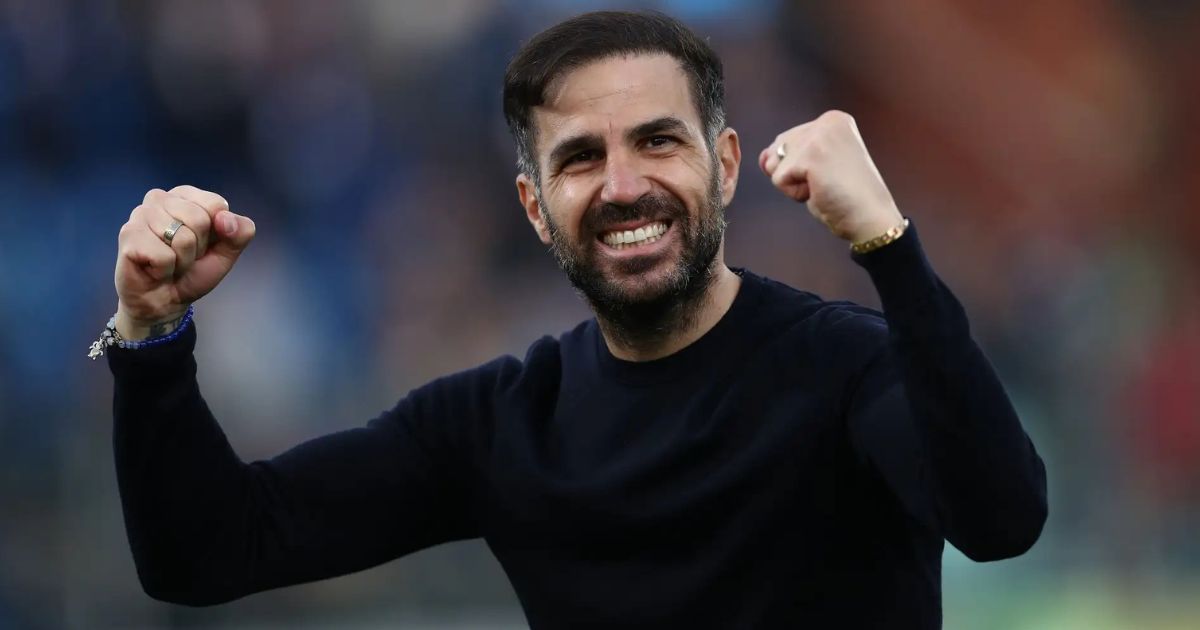
From helping Como return to Serie A after more than two decades to masterminding a historic 9-1 Champions League demolition of Lens, Cesc Fabregas is rapidly establishing himself as one of the most exciting young managers in world football.
ALSO READ: Gabriel & Konsa: The Best Centre-Back Partnership In World Football?
The former Arsenal, Barcelona and Chelsea midfielder has overseen one of European football’s most extraordinary transformations, turning a club that was playing in Italy’s fourth tier less than a decade ago into a genuine force in Serie A and an increasingly dangerous proposition on the continental stage.
Wednesday night’s astonishing victory over Lens was the latest demonstration of Fabregas’ remarkable coaching ability. Just two weeks earlier, his side dismantled Manchester United 4-1, producing a performance that showcased their tactical intelligence, attacking ambition and growing confidence against Europe’s traditional heavyweights.
At just 39, Fabregas has already achieved what many experienced managers spend entire careers pursuing: transforming a relatively modest club into one capable of competing with the continent’s elite.
And with Como now making waves in the Champions League, the question is becoming increasingly difficult to ignore.
Is Cesc Fabregas the best young coach in world football, and how long can Como realistically keep him away from Europe’s biggest clubs?
Como equal the biggest win in Champions League history 😱#UCL pic.twitter.com/H9M6ER0Jug
— UEFA Champions League (@ChampionsLeague) November 4, 2026
From Serie B To The Champions League: Como’s Extraordinary Rise
To appreciate the scale of Fabregas’ achievements, it is important to understand where Como were before his arrival.
As recently as 2019, the Italian club were competing in Serie D, a world away from the glamour, financial resources and international recognition associated with the Champions League.
Fabregas joined Como as a player in 2022, bringing an illustrious career that included Premier League titles with Chelsea, major domestic honours with Barcelona and two European Championships and a World Cup with Spain.
When he retired in 2023, he began his coaching journey with Como’s youth team before becoming involved with the senior side during their push for promotion.
Working alongside Osian Roberts, Fabregas helped guide Como back to Serie A in 2024, ending a 21-year absence from the Italian top flight.
It is worth making an important distinction: Fabregas was not the sole architect of that promotion. Roberts held the senior coaching role during the decisive period, with Fabregas serving as an assistant while developing his qualifications.
Nevertheless, the Spaniard was already becoming an increasingly influential figure in the club’s long-term project.
After taking sole charge, Fabregas guided Como to a respectable 10th-place finish in their first season back in Serie A.
For most newly promoted clubs, simply avoiding relegation would have represented success. Como, however, had considerably greater ambitions.
The following season, Fabregas delivered an achievement that few could have imagined.
Como finished fourth in Serie A in 2025/26, securing Champions League qualification for the first time in the club’s history.
In just two seasons, they had gone from newly promoted outsiders to one of Italy’s four best teams.
That progression is remarkable enough, but what makes it particularly impressive is the manner in which Fabregas has achieved it.
Rather than relying on defensive football and attempting to frustrate stronger opponents, Como have developed an ambitious, possession-based identity built around intelligent movement, technical quality and attacking freedom.
Their success has not been accidental. It is the result of a clearly defined footballing philosophy, intelligent recruitment and a manager who appears capable of extracting extraordinary performances from developing players.
The Night Como Humiliated Manchester United
If Como’s fourth-place finish in Serie A announced Fabregas as one of Europe’s most promising coaches, their Champions League victory over Manchester United demonstrated that his side could compete with the continent’s biggest names.
On 21 October, the Italian newcomers welcomed the three-time European champions to the Stadio Giuseppe Sinigaglia for a historic encounter.
Few would have predicted what followed.
Como produced a magnificent attacking performance to defeat United 4-1, with Nico Paz scoring twice and Tasos Douvikas and Jacobo Ramon also finding the back of the net.
Paz opened the scoring after just two minutes, immediately setting the tone for an evening in which Fabregas’ side repeatedly exposed United’s defensive weaknesses.
The hosts dominated possession for significant periods, moved the ball intelligently through midfield and created opportunities with quick combinations and incisive passing.
Their second goal perfectly illustrated Fabregas’ attacking philosophy, with an intricate passing move involving Lucas Da Cunha, Martin Baturina and Paz releasing Douvikas through on goal.
By the time Ramon added Como’s fourth in the 76th minute, United had been thoroughly outplayed.
Joshua Zirkzee’s late consolation did little to disguise the gulf between the teams on the night.
For a club making its Champions League debut, defeating Manchester United would have been a remarkable achievement under any circumstances.
But the manner of Como’s victory made it particularly significant.
They did not scrape a narrow win through defensive resistance or a fortunate counterattack. They imposed their style on one of the biggest clubs in world football and comprehensively outplayed them.
It was a tactical masterclass from Fabregas and a powerful demonstration of how far Como have progressed under his leadership.
The result also highlighted the influence of Paz, whose creativity, movement and technical ability have made him one of the most exciting young players in European football.
His development under Fabregas is another important aspect of Como’s success, demonstrating the Spaniard’s ability to nurture talent while producing results at the highest level.
At 4-0 up against Man Utd, Cesc Fàbregas admitted he told his Como players to slow down and later regretted it.
— Football on TNT Sports (@footballontnt) November 4, 2026
Two Champions League games later, Como scored NINE goals in a single match 😳 pic.twitter.com/DyeR3rJLm0
Nine Goals Against Lens: A Champions League Masterclass For The Ages
Just when it seemed Como’s victory over Manchester United could not be surpassed, Fabregas and his players produced something even more extraordinary.
On Wednesday night, the Italian side travelled to France to face Lens in their fourth Champions League fixture.
What followed was one of the most astonishing results in the competition’s history.
Como demolished Lens 9-1, equalling the biggest winning margin in the modern Champions League era and becoming the first team to score nine goals away from home in the competition.
Douvikas led the destruction with a hat-trick, while Paz, Da Cunha, Marc-Oliver Kempf, Mattia Liberali, Martin Baturina and teenage debutant Matteo Papaccioli also scored.
The performance was a remarkable exhibition of attacking football.
Como moved the ball with confidence, exploited spaces ruthlessly and demonstrated an extraordinary ability to turn promising attacking situations into clear goalscoring opportunities.
They were already three goals ahead at halftime, but rather than protecting their advantage, Fabregas’ side continued attacking with the same intensity.
By the final whistle, Como had scored nine goals from a performance that will be remembered as one of the most remarkable in Champions League history.
The victory also lifted them to fourth in the league-phase standings with nine points from four matches.
For a club experiencing European football’s premier competition for the first time, that represents an exceptional start.
Perhaps even more impressive was Fabregas’ reaction.
Rather than becoming carried away by the historic result, the Spaniard emphasised the importance of remaining humble, continuing to improve and maintaining focus on the challenges ahead.
That response offered another glimpse of his managerial maturity.
At 39, Fabregas already appears to understand that success is not simply about producing extraordinary individual performances, but sustaining the standards that make those performances possible.
The Fabregas Philosophy: A Student Of Football’s Greatest Minds
What makes Fabregas such an exciting coaching prospect is that his success at Como is built on a clear tactical identity rather than simply assembling a talented squad.
Throughout his playing career, the Spaniard enjoyed the rare privilege of working under some of football’s most influential managers, including Arsene Wenger, Pep Guardiola and Jose Mourinho.
Each offered a different education.
Wenger encouraged technical excellence, attacking freedom and intelligent movement. Guardiola placed enormous emphasis on positional play, possession and controlling matches through the ball. Mourinho demonstrated the importance of tactical discipline, defensive organisation and understanding how to exploit an opponent’s weaknesses.
Fabregas appears to have absorbed elements of all three philosophies while developing his own approach.
His Como side are comfortable playing out from the back, use intricate passing combinations to progress through midfield and encourage attacking players to interchange positions.
However, they are not simply interested in keeping possession for the sake of it.
There is purpose behind their passing.
Como regularly attempt to draw opponents forward before exploiting the spaces left behind, while their attacking players are encouraged to make intelligent runs between defensive lines.
That approach was particularly evident against Manchester United, where the movement of Paz, Baturina and Douvikas repeatedly created problems for the visitors.
Their destruction of Lens provided another example of their attacking flexibility, with Fabregas’ side combining patient build-up play with devastating transitions.
Perhaps most importantly, Fabregas has demonstrated that he is not afraid to impose his philosophy against stronger opposition.
In an interview with UEFA, the Spaniard explained that he wants his teams to remain faithful to their identity, even when facing opponents with greater individual quality.
That conviction is an important quality in a modern manager.
However, tactical intelligence alone does not explain Como’s success.
Fabregas has also established an environment in which young players can develop, make mistakes and express themselves without abandoning the team’s collective responsibilities.
His work with Paz is a particularly compelling example.
The Argentine midfielder has flourished under Fabregas, developing into a player capable of influencing Champions League matches through his creativity, technical ability and goalscoring contributions.
At a time when Europe’s biggest clubs are increasingly focused on developing young talent, Fabregas’ ability to combine player development with competitive success makes him an especially attractive managerial prospect.
Is Fabregas The Best Young Coach In World Football?
There is certainly a strong argument.
Football has no shortage of talented young managers, and the likes of Fabian Hurzeler, Vincent Kompany, Julian Nagelsmann and other progressive coaches have demonstrated that age is no barrier to tactical innovation or success.
However, what separates Fabregas from many of his contemporaries is the speed and scale of Como’s transformation.
He has helped take a club from Serie B to Serie A, established them in the Italian top flight, guided them into the Champions League and subsequently overseen historic victories against established European opposition.
All before his 40th birthday.
That is an extraordinary coaching CV for someone still relatively inexperienced in senior management.
Of course, Como’s transformation has also benefited from ambitious ownership, significant investment and an effective recruitment structure. It would be misleading to suggest Fabregas achieved everything without substantial institutional support.
But money alone does not guarantee success.
Plenty of ambitious clubs have spent heavily without developing a coherent identity or producing results that justify their investment.
Fabregas has helped turn Como’s resources into a competitive, exciting and increasingly successful football team.
There is also an important distinction between being the most accomplished young coach and the most exciting.
Managers such as Kompany have already experienced the pressure of leading major European clubs and competing for the biggest trophies.
Fabregas has yet to prove himself across multiple seasons at a club where winning major silverware is an expectation rather than an ambition.
That remains an important test.
Nevertheless, when considering the difficulty of the project he inherited, the progress his team has made and the football they are producing, Fabregas has as strong a claim as anyone to being the most exciting young coach in world football.
And if Como continue performing at their current level, that argument will only become more convincing.
Why Europe’s Biggest Clubs Should Be Watching
It would be surprising if Fabregas were not already featuring prominently in the long-term planning of Europe’s biggest clubs.
His combination of tactical intelligence, elite playing experience, player-development ability and increasingly impressive managerial results makes him an obvious candidate for future vacancies.
Crucially, he also possesses something that many promising coaches lack: first-hand experience of the expectations and pressures associated with football’s biggest institutions.
Fabregas spent his playing career representing Arsenal, Barcelona and Chelsea, winning major trophies and competing against the world’s best players.
He understands what it means to operate in dressing rooms filled with international superstars.
That experience does not automatically make someone a successful manager, but it could prove valuable when dealing with the personalities and expectations that accompany a major European appointment.
His connections to those clubs also make him an intriguing potential candidate should managerial vacancies arise.
Indeed, interest in Fabregas is not merely hypothetical.
Inter Milan and RB Leipzig previously explored the possibility of appointing him, while reports have also linked him with Manchester City, Real Madrid and Bayer Leverkusen.
However, Fabregas has consistently emphasised his commitment to Como’s long-term project, where he enjoys considerable influence and the freedom to implement his footballing ideas.
That raises an interesting question.
Would leaving Como for a bigger club necessarily represent the right move at this stage of his career?
There is a strong argument that another season or two in Italy could be invaluable.
Fabregas is still developing as a coach, and Como provide an environment where he can continue refining his philosophy without the immediate expectation of winning league titles or European trophies.
Nevertheless, opportunities at the biggest clubs do not always arrive at convenient moments.
If he continues delivering results of this magnitude, Fabregas may soon face a decision that could define the next chapter of his managerial career.
Barcelona: The Perfect Destination After Hansi Flick?
Of all the clubs that could eventually pursue Fabregas, Barcelona arguably represent the most natural destination.
The former Spanish international spent three seasons at the Catalan giants after returning from Arsenal in 2011, having originally developed through Barcelona’s famous La Masia academy.
He understands the club’s identity, its expectations and the importance supporters place on playing attractive, possession-based football.
More importantly, his coaching philosophy appears remarkably compatible with Barcelona’s traditional principles.
Fabregas favours technically gifted players, intelligent positional movement, attacking football and controlling matches through possession.
Those characteristics are deeply embedded in Barcelona’s footballing identity.
His experience working under Guardiola would also make him an intriguing candidate to continue the club’s commitment to progressive, attacking football.
However, this is not an argument for Barcelona to replace Hansi Flick immediately.
The German has enjoyed considerable success since taking charge, restoring Barcelona’s competitiveness and establishing an exciting team built around young talents such as Lamine Yamal and Pedri.
His current contract runs until 2028, and there is no indication that Barcelona are actively seeking an immediate replacement.
Nevertheless, every successful club must eventually consider succession planning.
When Flick decides to leave, Barcelona will need a manager capable of maintaining their attacking identity while continuing to develop the next generation of talent.
Fabregas could be an outstanding candidate.
His work with Como suggests he possesses the tactical intelligence required to manage a technically demanding team, while his ability to improve young players would align perfectly with Barcelona’s reliance on academy graduates.
His familiarity with the club’s culture would also be an advantage.
Interestingly, reports from Spain suggest Barcelona have already identified Fabregas as a potential future successor to Flick.
According to reporting attributed to Sport, the former midfielder is highly regarded within the club’s hierarchy, while separate reports claim his Como contract includes a favourable release clause for Barcelona, Arsenal and Chelsea.
Those claims have not been independently confirmed by the clubs, but they underline the growing speculation surrounding his future.
The idea of Fabregas eventually returning to Barcelona as head coach is therefore more than a romantic footballing possibility.
It is a scenario that makes considerable sense from a tactical, cultural and developmental perspective.
There would still be challenges, of course.
Managing Barcelona means dealing with enormous expectations, intense media scrutiny and the pressure of competing for major trophies every season.
Fabregas would also need to demonstrate that his methods can succeed consistently against Europe’s strongest teams over a longer period.
But if he continues developing at his current rate, he could be exceptionally well-positioned when the opportunity eventually arises.
Barcelona should not be looking to replace Flick. They should, however, be making absolutely certain that Fabregas remains on their radar.

BetJets News is crafted by a team of dedicated sports writers and betting experts. With deep knowledge of soccer, cricket, rugby, and more, our contributors deliver insightful tips, match previews, and betting strategies to help you make smarter bets.